American Mah Jongg has a vocabulary of its own, and a lot of it is borrowed from nowhere else in the mahjong family. Here is the short version, in plain words. If you are starting from zero, read how to play first and come back to this.
Bam
One of the three suits, numbered 1 to 9. Short for bamboo, and sometimes called sticks. The green dragon is the bams' dragon.
Blind pass
The third and sixth Charleston passes, where you may pass on tiles without looking at them.
The card
The sheet listing every hand you are allowed to win with. Not a suggestion — if your tiles do not match a line on it, you cannot declare. Ours is free to read and print.
Charleston
The opening ritual of passing tiles around the table, three at a time. Seven passes in full.
Concealed
A line marked C, which you may not claim a discard for — every tile has to be drawn. Concealed lines pay more.
Courtesy pass
The final Charleston pass, across the table, of nought to three tiles, exchanged at the lower of the two offers.
Crak
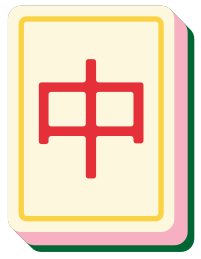
One of the three suits, numbered 1 to 9, marked with Chinese characters. The red dragon is the craks' dragon.
Dead hand
A hand whose exposures can no longer reach any line on the card. It cannot win, and the player sits out the rest of the hand.
Dot
One of the three suits, numbered 1 to 9, marked with circles. Sometimes called balls. The white dragon is the dots' dragon.
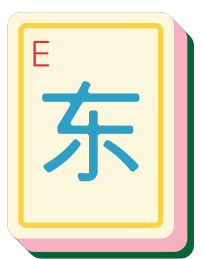
East
The dealer. East breaks her own wall in American mahjong, which is unusual — in most traditions the dice send you to somebody else's.
Exposure
A block laid face-up on the table after claiming a discard. It is public information and a commitment, and it is how the table works out what you are building.
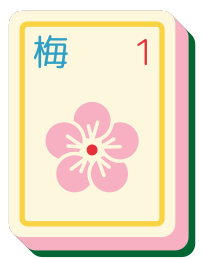
Flower
The eight flower and season tiles. In American mahjong they are ordinary hand tiles that lines ask for by name — nothing is set aside and nothing is replaced.
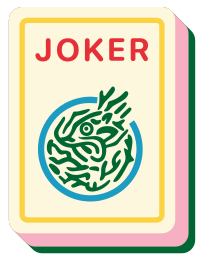
Joker
A wild tile, eight in the wall, usable only inside a block of three or more identical tiles. The one rule.
Joker exchange
Swapping a real tile into an exposed group where a joker is doing that tile's job, and taking the joker. Your turn only.
Jokerless
A winning hand containing no joker. At most tables it pays double.
Kong
Four identical tiles. In American mahjong a kong draws no replacement tile — you lay it and play continues, which trips up players from every other tradition.
Mah Jongg
The call you make when your hand matches a line on the card. Also the name of the game, spelled two ways: mahjong and mah jongg.
Pair
Two identical tiles. No joker can ever fill one.
Pung
Three identical tiles. Jokers welcome.
Quint
Five identical tiles. Impossible without a joker, since the wall holds only four of anything.
Single
One tile, asked for by name by a line. No joker can fill one.
Singles & Pairs
The section of the card built entirely from singles and pairs, therefore jokerless, therefore the most valuable and the hardest.
Soap
The white dragon, used as the digit zero in year hands — which is why a 2026 line wants one.
Wall
The 152 tiles the hand is dealt and drawn from: the usual 136 plus eight flowers and eight jokers.
Wall game
Nobody declares before the wall runs out. Nobody pays, and the dealer deals again.
Year hand
A line from the year section of the card, spelling the year in tiles.
Seeing them in play
Names stick faster when something is using them properly. More Mahjong deals the More Mahjong Card 2026 against three opponents, names every call as it happens, and enforces all of the above. See also the card's nine sections, the Charleston and jokers.