In American Mah Jongg you do not win with any four sets and a pair. You win with one specific line printed on a card, and if your fourteen tiles do not match a line, they are not a winning hand no matter how tidy they look. That single rule is what makes this game a puzzle rather than a race, and it is why every American player has a card in front of them the whole time.
This page walks the nine sections of the More Mahjong Card 2026 — 72 hands, values 25 to 55, 8 of them concealed. It is our own card, written for this app, which is why we can print it here in full and give you a printable copy. Most American cards are licensed material that nobody may reproduce.
Reading a line
Every line is 14 tiles, and the color is the rule, not the decoration: blocks printed in one color must all be the same suit, and a different color must be a different suit. That is all “2 suits” beside a line means — how many, never which. F is any flower, D the dragon belonging to that block's suit, 0 the soap, and C marks a line that must stay concealed.
One rule decides more of this game than any other: a joker can stand in only inside a block of three or more identical tiles. Never a pair, never a single, never a mixed block. Read the sections below with that in mind and you can see, at a glance, which lines your jokers are allowed to rescue.
2026 — the year section
The year section spells the year in tiles. The 0 is the soap — the white dragon, standing in as a digit — which is the first thing that confuses a player coming from any other mahjong. A year section is reissued every year, so it is the part of any card that dates it.
7 lines · 25–35 points. Two of them, as the card prints them:
| FF 2026 2026 2026 | 3 suits | 30 |
| FFFF 2026 2026 DD | 3 suits | 30 |
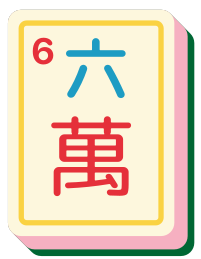
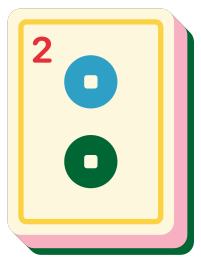
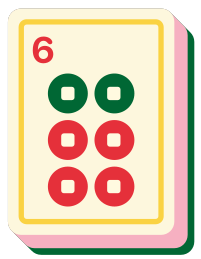
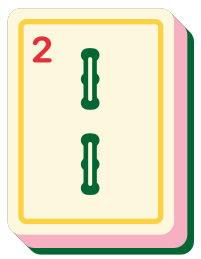
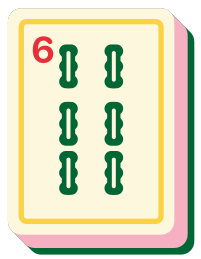
2468
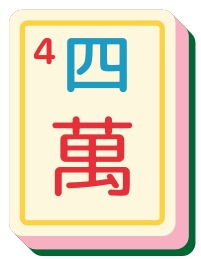
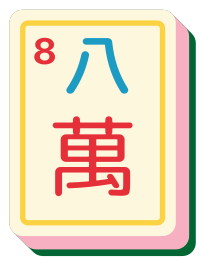
Even numbers only, and nothing else: 2, 4, 6 and 8 across the three suits. Note what that does to jokers. A block written 2468 is four different tiles, so no joker can touch it — but a block written 4444 is four identical ones, and a joker is welcome.
10 lines · 25–40 points. Two of them, as the card prints them:
| 222 4444 666 8888 | 1 suit | 25 |
| FF 2222 4444 6666 | 3 suits | 25 |
Any Matching Numbers
The line gives you the shape and lets you choose the digits. Where another section pins you to specific numbers, these say only “some number, then the same number again in another suit” — which makes them the most forgiving lines on the card and the usual advice for a first hand.
8 lines · 25–35 points. Two of them, as the card prints them:
| FF 1111 1111 1111 | 3 suits | 25 |
| 111 DDD 111 DDD 11 | 3 suits | 35 |
Consecutive Numbers
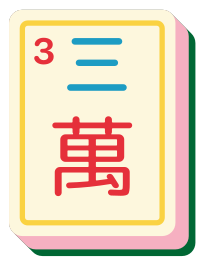
Runs of adjacent numbers — 1 2 3, or 4 5 6 — rather than matching ones. The largest section on the card, and the one that rewards a rack that came out of the Charleston with a lot of one suit in a narrow range.
11 lines · 25–40 points. Two of them, as the card prints them:
| 111 2222 333 4444 | 1 suit | 25 |
| FFF 111 222 111 22 | 2 suits | 25 |
13579
Odd numbers only, the mirror of 2468. Worth knowing as a pair: if your deal is lopsidedly odd or lopsidedly even, one of these two sections is already telling you where to go.
10 lines · 25–45 points. Two of them, as the card prints them:
| 11 333 5555 333 11 | 2 suits | 25 |
| FF 1111 3333 5555 | 3 suits | 25 |
Winds – Dragons
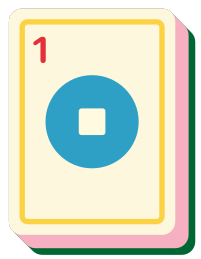
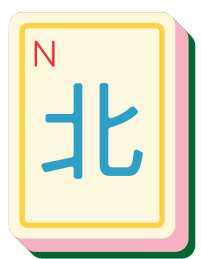
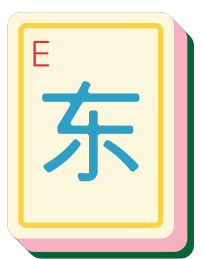
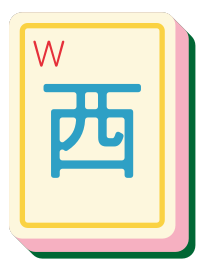
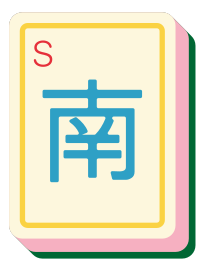
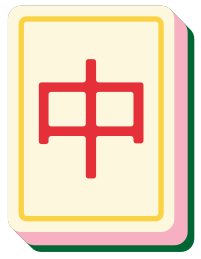
Built from the four winds and the three dragons. Winds belong to no suit, so they take no color on the card and a “2 suits” note on one of these lines is counting the dragon blocks, not the winds.
8 lines · 30–45 points. Two of them, as the card prints them:
| NNN EEE WWW SSS DD | 1 dragon | 30 |
| FF DDDD DDDD DDDD | 3 dragons | 35 |
369
Multiples of three. The same idea as 2468 and 13579 — a fixed set of digits — with the loosest spacing of the three, which is why a 369 line is often reachable from a hand that started out looking like nothing.
7 lines · 25–40 points · 1 concealed. Two of them, as the card prints them:
| 333 666 999 333 66 | 2 suits | 30 |
| 333 666 999 DDD 33 | 3 suits | 30 |
Quints
Five identical tiles. There are only four of any tile in the wall, so a quint is impossible without a joker — every quint line is a bet that you can hold or steal one. They are priced accordingly.
4 lines · 40–50 points. Two of them, as the card prints them:
| 11111 22222 FFFF | 2 suits | 40 |
| 11111 DDDD 11111 | 3 suits | 45 |
Singles & Pairs
No block bigger than a pair, which means no joker can ever help you — a joker only stands in inside a group of three or more identical tiles. These are the hardest lines on the card and the most valuable, and you cannot claim a discard for them.
7 lines · 50–55 points · 7 concealed. Two of them, as the card prints them:
| FF 11 33 55 77 99 11 | 2 suits | 50 |
| NEWS 2026 2026 FF | 2 suits | 50 |
Which lines will your jokers help?
Sort the card by that question and it gets much smaller. Blocks of three, four or five identical tiles take jokers — so pungs, kongs and every quint are joker country. Mixed blocks like 2468 or NEWS, and every pair or single, take none. Singles & Pairs is jokerless from end to end, which is exactly why it pays the most.
The practical version: a rack with two jokers should be looking at pungs and kongs, and a rack with none should stop pretending it is going to finish a quint.
Practicing this without a table
Reading a card and playing one are different skills, and the second only comes from repetitions. More Mahjong deals this exact card against three opponents, ranks every line by how close your hand is to it, grays out the lines your exposures have already killed, and refuses any win that is not card-legal — so you cannot learn a wrong hand by accident. Then print the card and take it to a real table.