- Hand size
- 13 tiles
- Winning shape
- A line printed on the card
- Wall
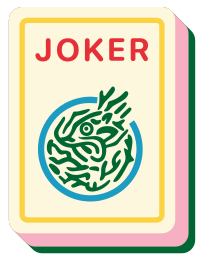
- 152 tiles, including eight jokers
- Scoring
- The value printed beside your line
- Signature
- The Charleston, and the joker exchange
American Mah Jongg is the outlier, and the one most likely to confuse a player who learned anywhere else. You are not building runs and triplets freely — you are building one specific hand printed on a card, and if your tiles don't match a line on that card, you cannot win with them.
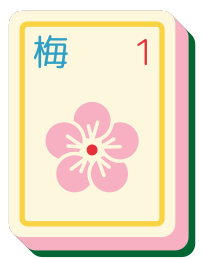
The wall is 152 tiles rather than 136, because it includes eight jokers. Flowers are ordinary hand tiles here, not bonuses: nothing is set aside, nothing is replaced. Hands are 13 tiles.
The card
Each line on the card is a pattern — groups of matching numbers, runs, winds, dragons — with a point value beside it and conditions attached: this suit or any suit, concealed or exposed. Choosing which line to chase, and knowing when your line has died, is the entire game. It is closer to a puzzle than to the tile-reading of the Chinese games.
More Mahjong wrote its own card, and gives it away. The More Mahjong Card 2026 is 72 hands across nine sections — This Year, 2468, Any Matching Numbers, Consecutive Numbers, 13579, Winds & Dragons, 369, Quints, and Singles & Pairs. It ships inside the app, so the card on your screen and the card in your hand are the same card, and it is free to read and free to print whether you ever install anything or not.
New to it? Start with how to play American Mah Jongg, or read what the nine sections of the card actually mean.
The Charleston
Before play, tiles move around the table in a fixed sequence: three right, three across, three left — that third pass blind, meaning you pass tiles you haven't seen. Then, if all four players agree, a second set of three. Then a courtesy pass of nought to three tiles across, exchanged at the lower of the two offers.
It is the most social ritual in any mahjong variant, and it is where a hopeless deal becomes playable.
Jokers
Jokers are wild, but not everywhere. A joker can stand in within a group of three or more identical tiles — never in a pair, never in a single, never in a mixed run. That single rule is why Singles and Pairs hands are jokerless by construction, and why hoarding jokers is not automatically correct.
You can also exchange for one: on your turn, swap a real tile into an exposed group where a joker is doing that tile's job, and take the joker.
What the app enforces
- Only card-legal wins, matched against the whole card
- Exposures that map onto whole uniform groups, jokers included
- Jokers wild in groups of three or more identical tiles, and nowhere else
- All seven Charleston passes, the blind pass, the vote, and the courtesy exchange
- The joker exchange, on your turn only
- Kongs that draw no replacement tile — an American rule that trips up everyone else
- East breaking her own wall
The Card page shows the closest line to your hand tile by tile — what you hold, what you still need, and which jokers are doing work — and folds away the lines your exposures have already killed.